

Events

Feb 19, 2026 • 5 min read

Topic
Author
In This Blog
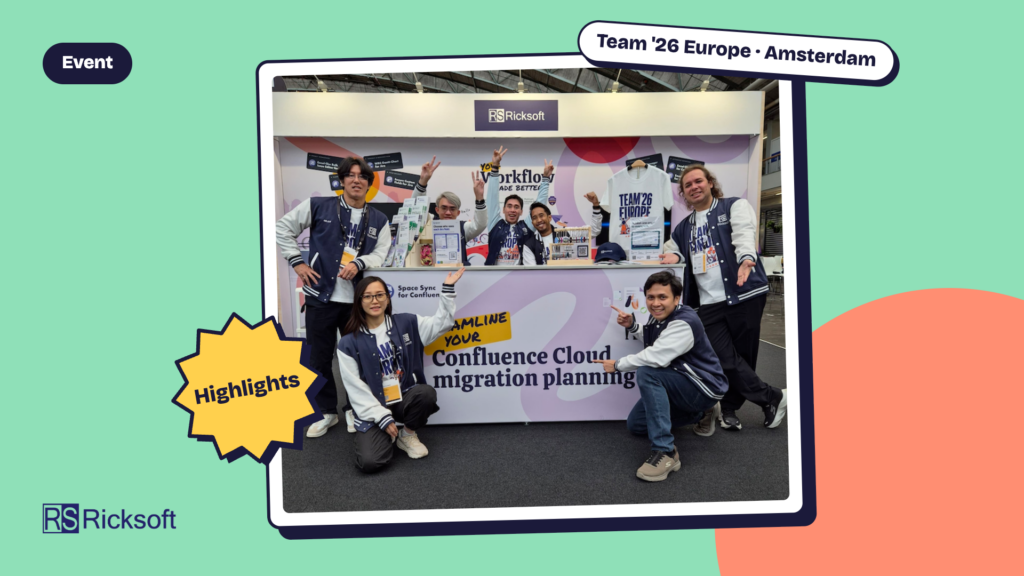
📅 February 9–13, 2026 | 📍 Amsterdam, Netherlands
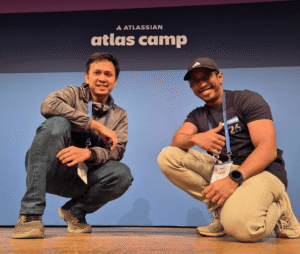
We’re back for another round of Atlas Camp: Atlassian’s week-long conference for the people building on its platform. Like last year, Raziman Dom (Head of Product) and Khairul Danial (Technical Product Manager) represented Ricksoft in Amsterdam. Over 320 developers showed up this year, from Fortune 500 R&D teams to Marketplace builders to AI-native makers.
If last year’s Atlas Camp was about meeting Rovo, this year was about putting it to work.
Days 1 and 2 were the conference proper. The opening keynote, led by Tiffany To (EVP, Enterprise and Platform) and Alan Braun (VP, Ecosystem and Marketplace), made the case that AI will mean more developers, not fewer — with Rovo Dev and Forge positioned as the force multiplier. A few things stood out:
Three EAPs opened up to partners: Teamwork Graph connectors and APIs (build apps and agents on top of Atlassian’s own knowledge graph), Forge-hosted LLMs powered by Amazon Bedrock (AI features that still qualify for Runs on Atlassian, without managing your own model infrastructure), and a Forge Container Service for longer-running or non-standard workloads.
The closing keynote panel — Sven Peters (AI & Dev Evangelist) with Reena Agarwal (Head of Engineering, Ecosystem and Marketplace) and Nitin Kumar (Senior Partner Solution Architect, AWS) — argued AI works best as a teammate, not a replacement. One stat that stuck: developer happiness at Atlassian reportedly climbed from 49% to 83% since leaning into this approach.
Top sessions covered how Atlassian scaled its own CI/CD on Bitbucket and Forge (over a billion minutes of automation), a new rolling-releases model for app delivery that decouples permissions from versions, and how Teamwork Graph connectors can pull scattered data from tools like Jira, Confluence, Slack, and Notion into one knowledge graph.
Days 3–5 shift into hands-on build time, and this year we went in with a real question: how far can Rovo Dev actually take us, beyond the demos?
Rovo Dev has two halves worth knowing about — a CLI that works directly against your codebase (writing commands, refactoring, generating changes), and a native integration that works inside Atlassian tools themselves, like generating code straight from a Jira description. The CLI is built for developers; the native integration is genuinely usable by PMs and other non-technical folks too.
Raziman used the week to build a Forge app entirely from scratch with Rovo Dev. Khairul focused on something more practical: using it to accelerate a Connect-to-Forge migration on one of our Excel-based Confluence apps.
A few concrete results:
Migration got measurably faster. Rovo Dev rebuilt one of our app’s core modules as a Forge-based implementation — not perfectly in one prompt, but with a few rounds of refinement, the backend implementation held up well. It’s a real signal that Rovo Dev can meaningfully speed up Forge migration work, not just prototype toy examples.
We prototyped a few AI-powered formulas — natural-language query, translate, summarize, and pivot-table analysis — directly inside one of our spreadsheet-style apps. None of it is production-ready, but the results were good enough to take seriously.
Forge Container turned out to be the wrong tool for collaboration features — it’s stateless, so it can’t hold the persistent state that real-time, multi-user editing needs. Atlassian’s PM for Forge Container, Joe Clark, confirmed this and pointed us toward Realtime Events instead, which removes the need for expensive polling — though getting it working with our existing spreadsheet component wasn’t plug-and-play.
We gave direct EAP feedback on the new Forge Full Screen Modal, which currently strips out the toolbar entirely — a real issue for us, since several of our apps rely on a fullscreen view. The lesson we’d pass on to any other partner: give your feedback while a feature is still in EAP. Once something reaches general availability, it’s much harder to change.
MCP servers turned out to matter more than we expected. Think of an MCP server as a reference book you hand your AI agent — without one, we noticed Rovo Dev would sometimes suggest deprecated APIs by default. Connecting the Forge MCP server fixed that. We also learned Rovo can connect to a Figma MCP server, which we haven’t tried yet but expect could tighten the loop between design and engineering.
And yes — Khairul burned through a day and a half of Rovo Dev credits by the second day, from testing too aggressively. Fair trade for a hackathon week. 😅
Raziman’s from-scratch Forge app, built entirely with Rovo Dev during the workshop, won “Best ‘From Zero to Value’ Journey” at Atlas Camp’s closing showcase. Congrats, Razi!
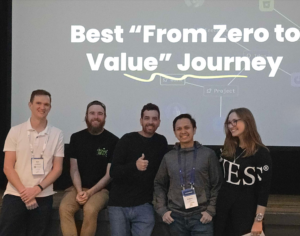
Atlas Camp always hands you more ideas than you have time for. The recurring question for us as a product team is less “what’s new” and more “what’s actually usable”. It’s easy to get excited about an announcement and much harder to turn it into something that helps a real app.
That’s where Rovo Dev earned its keep this year. Instead of just speculating about what a new Forge feature could do, we could test it, prototype it, and see what actually held up fast. That alone made the week’s exploration feel a lot lighter than it has in past years.
We’re already thinking about where Rovo Dev fits into our regular workflow going forward: starting with migration work and rapid proof-of-concepts for new Forge features.
Thanks to Atlassian for another great week, and we’re already looking forward to the next one.