


Events
Oct 12, 2026 • 5 min read
Topic
Author
In This Blog
📅 October 6–8, 2026 | 📍 RAI Amsterdam, Netherlands
Thousands of Atlassian customers, partners, and Atlassians spent three days in Amsterdam on one question: what does teamwork look like once agents are on the team? Ricksoft was there as a Signature Sponsor. Here’s the recap.
📺 Missed a session? Atlassian’s on-demand library is available here, or catch it on the official Team ’26 Europe YouTube playlist.
Mike Cannon-Brookes declared the end of single-player AI. “Working with AI isn’t single player any more — it’s multiplayer.” He pitched the Atlassian platform as a company’s central nervous system, supplying the context and collaboration workers need.
AMP is a protocol for people as much as for software. Cannon-Brookes said to treat the new Agentic Multiplayer Protocol “more as a diplomatic protocol than a technical protocol.” It builds on MCP and A2A, but its real job is to make four modes of work clear in the UI: a human acting, an agent with its own identity, an agent acting for a human, and a human assisted by an agent.
Context is the moat. Chief Product & AI Officer Tamar Yehoshua took the stage with a long list of Teamwork Graph improvements. Cannon-Brookes later argued that Atlassian’s graph is among the best in enterprise AI. He predicted that most large organizations will run three to five context graphs and said Atlassian intends to be one of them in every large company.
A home-market customer story. VodafoneZiggo, one of the Netherlands’ largest network providers, was named 2026 Atlassian Impact Maker. Technical Platform Lead Basak Erdogan described how its Atlassian rollout began in marketing and spread across business and tech teams. Agent interactions grew from 100 to 2,000, and active AI users rose five-fold in five months.
And one unscripted moment: a power cut briefly halted proceedings just as the opening keynote was wrapping up. Even agentic platforms still need electricity.
Agentic Multiplayer Protocol (AMP). A new identity class covers agents, apps, and service accounts. Admins can extend or revoke their permissions, and a full audit trail records their activity, including token spend. Some non-human-identity inventory and access controls are still listed as coming soon.
Atlassian MCP Server, rebuilt. It went from dozens of tools to more than 200, covering nearly every Atlassian app plus Forge and Marketplace apps, with access governed by Atlassian Guard.
Agent Sessions. Cloud and local agent work now shows up in Jira and the Teamwork Graph, so context isn’t lost in someone’s terminal.
Rovo Work. A new Rovo Chat mode handles complex, multi-step tasks that humans review and approve. Rovo Code Search also launched.
Artifacts app. Output from ChatGPT, Claude, Rovo, or any other AI tool gets a permanent URL. It can be embedded in Confluence, Jira, or Slack, follows enterprise permissions, and is indexed into the Teamwork Graph.
Loom meets agents. Record for Agent turns a screen-and-voice recording into a brief an agent can act on. Interactive PR Reviews has agents record a Loom walkthrough of their own code changes in Bitbucket.
A bigger Teamwork Graph. It now handles structured data from tools like Redshift and Tableau, reads source code in more detail, and adds connectors for Zoom, Gong, Microsoft Entra ID, and Google Identity. It now spans 250 billion connected objects.
EU AI Inference. LLM processing can now be restricted to models hosted in the EU, and the announcement drew one of the biggest cheers of the week.
Expanded OpenAI partnership. OpenAI’s GPT-6 family models will power agents across Rovo and the platform. The two companies are also exploring deeper Jira integrations for assigning work to agents.
Governance was the real headline. Identity, audit trails, and data residency got more stage time than model capability. Analysts made the same point: frontier models are converging, so context and governance are what set agents apart.
Clean data still comes first. VodafoneZiggo’s story echoed what we heard in Anaheim. They finished a full workflow and field standardization cleanup after migrating from server to cloud, and they credit better data quality for better decisions.
Marketplace apps are now part of the agent picture. With the rebuilt MCP server reaching Forge and Marketplace apps, the planning data and tables teams keep in apps become context that agents can work with. It’s another reason we moved our full portfolio to Forge.
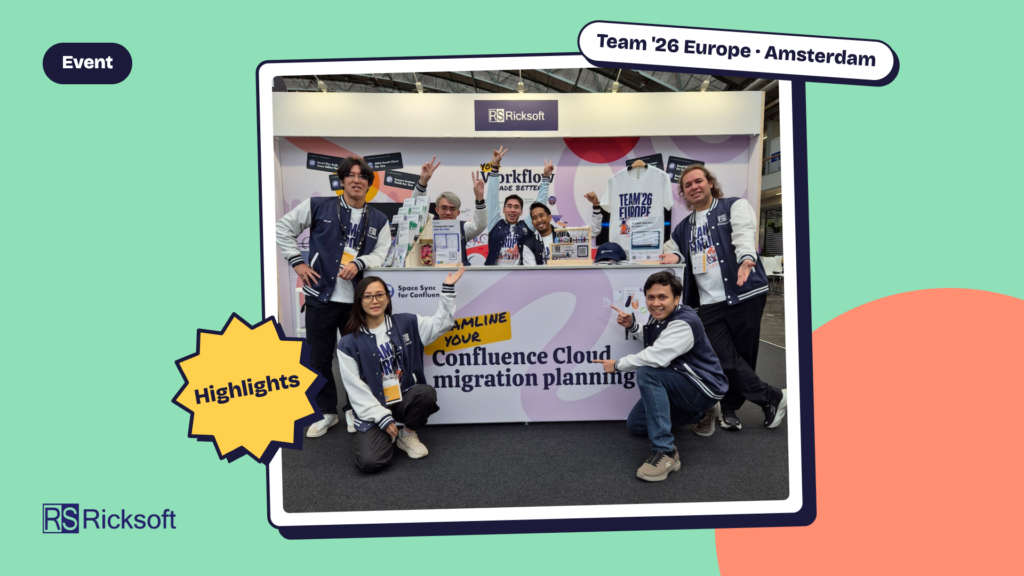
Three days, a lot of good conversations. Thank you to everyone who stopped by.
✔ Live product demos across our entire Jira and Confluence lineup
✔ Spotlight: Space Sync for Confluence. We showed how it keeps Cloud and Data Center content in sync, so teams migrating don’t have to freeze content mid-move.
✔ 1-on-1 consults with admins and team leads on project planning, custom fields, and migration
✔ Amsterdam-edition t-shirts. Thanks to everyone who grabbed one. We hope they make it into the rotation.
Missed us on the floor? You can still get a walkthrough of any of our apps. Book a demo here.
That wraps up Team events for 2026: Anaheim in May, Amsterdam in October. Thank you to everyone who came by on both continents.
Next up is Atlassian Team ’27 in San Francisco, April 20–22, 2027, and we’ll be there. More details closer to the date.
See you in San Francisco!

